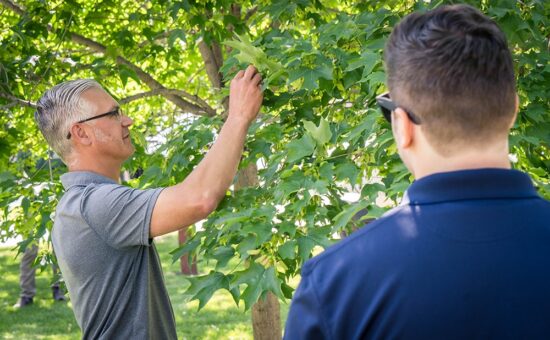
Rainbow Treecare’s Consulting Arborists are all Certified by the International Society of Arboriculture (ISA) and are individually assigned to neighborhoods throughout the Minneapolis and St. Paul metro. This allows our experts to provide the best tree care recommendations and services to your property.
ExcellentRainbow Treecare4.5★★★★☆ Based on 217 reviews fromSee all reviews review us onJeff W. ★★★★★ The guys from Rainbow Treecare did an excellent job removing a big ash tree between multiple power lines. And the clean up afterwards was great. Would highly recommend them.Gerry L. ★★★★★ Eric Lundstrom and Jocelyn “Josey” Anderson,The pin oak treatment, chlorides therapeutic treatment, that Josey applied to our tree last fall appears to have had a very positive effect. The oak tree has leaved out nicely, with all branches having leaves. The test will be on how green the leaves will get later this spring and how green they will stay this summer.As always, Eric, thank you for your professionalism, knowledge and guidance! And Josey for all your hard work!Gerry L.Dianne H. ★★★★★ Nate came out to treat our tree for Dutch elm disease. He professionally announced his presence, introducing himself, his affiliation with Rainbow and informing us the manner in which he would treat our Elm. Although our back yard is wooded and wild, Nate made sure upon leaving that the area surrounding the tree was raked and neat. In fact, it looked better than when he had arrived. Thanks, Nate. thanks, also to Jesse, a horticulturist, who evaluated our trees and told us how to protect them. Good people.Daniel M. ★★★★★ We recently had our Ash tree injection done for the European Ash Bore. The technician, Zach was great! He has wonderful customer skills as well!corey W. ★★★★★ Our pest experts tech was amazing! He was so polite and knowledgeable, and took great care to explain the process of the services provided. I highly recommend Rainbow Pest and all of their other service divisions!Alex A. ★★★★★ These fellas were professional, timely, respectful of our lawn & property, thorough, and - my favorite part - genuinely seemed to be having a good time at their job. (the tree trimmers looked like climbers & we're swinging/hanging/moving around like professional rock climbers who knew their equipment and capabilities well). What a difference that makes. They have my repeat business.ernest M. ★★★★★ Rainbow tree very is concerned about the health of your trees!James A. ★★★★★ Excellent work by a sharp crew.Tim B. ★★★★★ Webb did a great job. appreciate the attention to detail really focuses on exactly what needs to be done to help these trees Stay healthy. Super grateful.Wendell W. ★★★★☆ Need to phone for appointmentAlli T. ★★★★★ Great initial diagnostic service! Still need to have the follow-up tree service appointment, awaiting a call back to scheduleEd B. ★★★★★ Thanks to the tree removal and stump grinding teams.Very thorough and well done.Bruce P ★★★★★ We had several of our trees trimmed today, and what a wonderful job Rainbow did.It all started with a consultation with their Arborist, Jesse Belter. And he even came over this morning to give the details of the job to the crew.Mariah, Aaron, and Evan made a great team and worked together to make the work go efficiently. They were good communicators and were quick to offer suggestions and advice on how to make our property look its best. The Trees in our yard now look great.And what blew me away was how meticulous they were about cleaning up. Our yard never looked so good.Great job Rainbow !!Sean K. ★★★★★ We trust Rainbow with our 225 year old White Oak. They do incredible work!Mary Pat S. ★★★★★ We have had Rainbow Treecare out several times to deal with different issues, including treating our Ash tree for Emerald Ash Borer and treating and pruning our Spruce tree. Everyone who has come out has been very professional, thorough, and easy to work with. In particular, our area’s arborist, Sam, has been incredibly helpful and responsive. He takes the time to explain things and has always provided a quick and accurate quote for the work we are considering. For our latest call, Sam came out and dealt with a branch on a power line as a courtesy, which was much more than I was expecting and much appreciated! We have been very happy to have Sam as a resource, and we will certainly be calling him and Rainbow in the future. Highly recommend.Maja R. ★★★★★ Great work!Nathan R. ★★★★★ Cut down two large Elms in front yard that were dying. Had both down and hauled away while I was at work. Stump removal was about a month later. I talked with the worker, Reggie. He was very nice and enthusiastic for his job. It was hot and humid that day. He put wood between the machinery and grass to protect it. He described what he was doing and the procedure. He explained the aftercare and how to start growing grass. Hopefully you get Reggie. Cleaned up very nice as well.Megan M. ★★★★★ Terrific service! Yesterday afternoon a very large branch fell from the top of our linden but didn't drop to the yard. My rep, Sam, arrived early this morning to assess and decided, as a courtesy, he could take it down himself with strategic use of a pole saw, which he did in about 10 minutes. Extremely impressed and grateful!Matt B. ★★★★★ 1st time using Rainbow, great experience. Slow to schedule but absolutely worth it as we've discovered there are a lot of sketchy and unreliable contractors out there. Had a 40 ft white pine removed next to our pool so we were definitely worried about safety, power lines and the mess. We literally did not see a single speck of sawdust or leftover broken branch, either from the tree downing or the stump grinding afterward. Team super friendly, fast, and now it looks like there was never a tree there to begin with. Highly recommend.Rick L. ★★★★★ They came out in the middle of Feb. where we had a ton of snow on the ground and was still able to get the job done and done well (trimming and tree removal). Come April I got a knock on my door as they showed up to pick up all the twigs that had fallen but which they couldn't clean up because of the snow at the time they did the job.I was blown away when they came back. I thought that was something I'd have to deal with. Will keep coming back.Danielle M. ★★★★★ Very knowledgeable! Will definitely be reaching back out when the time comes for future treecare!Mike S. ★★★★★ Over the years Rainbow Treecare has performed everything from stump grinding to tree fertilization and insect control (including EAB) I trust the experts each time they have a suggestion concerning the health of my trees. They are extreemly knowledgeable and professional. There isn't anything they can't do! I reccomend Rainbow Treecare to anyone who has need of their services!Sincerely, Mike Spinner Victoria, MnMichael S. ★★★★★ Once again, Rainbow Treecare sets a high bar and then delivers service above the raised bar. Their crew was out today to trim a large tree in our backyard (Uptown zone) and when they completed the project, our yard was cleaner than it was before they arrived. The crew is truly well schooled in customer service and Rainbow Treecare remains our go-to for any and all tree services. If you are interested in consistent quality, contact them as you will pat yourself on the back for making the connection!Response from the ownerMichael - This is so great to hear! We will make sure it gets to the crew. Kelsey S. ★★★★★ Excellent all the way around. Eric Lundstrom, our area's arborist, has been to our home multiple times over the last few years and provided excellent insights and recommendations. The team that has come to our house to provide the recommended services take an unprecedented level of care in treating the trees and clean up. We just finished another service today and are very satisfied.Jim L. ★★★★★ Shout out to Sam (sales) and Nathan (foreman) for carefully walking us through the process to ensure that we were all on the same page before starting work on our maple tree. The work itself was perfect despite difficult weather conditions. Thanks!Kelsey J. ★★★★★ We used Rainbow Tree Company to trim a maple tree as well as a very tall spruce. We waited a few months for the appointment, but they were quick to bid the project and came at the appointment time. They hauled away the debris and did a great job trimming the two trees.Marc G. ★★★★★ Best ever no project to big. Highly recommendedJames K. ★★★★★ Rainbow Treecare has been our go-to company for tree issues for some time. A big part of our satisfaction is our visits from Charles Kastern, your arborist. He is unfailingly helpful, friendly, and polite. He answers all our questions knowledgeably, a great representative of your company.Alex S. ★★★★★ The Arborist Rainbow sent was extremely knowledgeable, he recommended treatment where needed and gave advice for diy care where it wasn't. Emerald ash borer protection service was scheduled quickly and for a reasonable price - great experience!Dave J. ★★★★★ I had a slight miscommunication about what was going to be a mulch bed and what was going to be grass. With one call a service appointment was made. Reggie and Eli came out for the service call and hot everything corrected and helped me with the straw mat to keep the dirt in place.Logan D. ★★★★★ Accommodating service with fair prices!Emily A. ★★★★★ Fast service for our EAB treatment and great communication.
Meet our team of trusted professional Consulting Arborists who are passionate about trees. We listen to our customers and their objectives and create proactive management plans that provide for healthy and beautiful landscapes.
We place cookies on your device to enhance site navigation, aid your browsing experience, analyze site usage, and serve you with relevant content. By clicking “Accept All”, you agree to our use of cookies for these purposes. For more information, review our Privacy Policy.